At the time of birth, our newborn babies transition from a completely sterile environment in the womb into the world we live in. During the birthing process, the child is exposed to bacteria in the birth canal as well as bacteria present in the delivery room from doctors, nurses, parents, or others. The child does not have his or her own immune system yet and won’t for about 6 months. The child receives passive immunity through the placenta from the mother’s blood in the form of the Immunoglobulin G (IgG) system representing the mother’s immune history.
(Immunoglobulins are the parts of the immune system that are analogous to the military – there are several branches: G,M,A,E, like the military has the Army, Air force, Marines, and Navy. They have different responsibilities, but all are there to protect us from the environment.)
Going from a sterile environment to one filled with no shortage of exposure to immune challenges in the form of bacteria, parasites, and viruses, the child depends on the healthy immune system of the mother. The IgG transfer through the placenta at birth is temporary and is soon replaced by the immunoglobulins present in the mother’s milk providing more protection and initiating another branch of the system called IgA, which is the immune system present in the gut of the child. The immune representation in the gut will become 85 percent of the immune system of that child for the rest of his or her life. It is through the gut that we develop immune tolerance to “good” bacteria and food proteins.
What is the immune system’s job?
- Protection against harmful antigens such as bad bacteria, viruses, and parasites.
- Tolerance to “good” bacteria (microbiota) and food proteins.
Tolerance prevents the child’s system from attacking every foreign protein that enters the body. The last thing we need to do is mount an immune response to broccoli, chicken, or healthy bacteria. That would be a disaster. Think about how you feel when your body is protecting you from bad bacteria or viruses – you get a fever, chills, muscle aches, and fatigue. If you did not have tolerance, you would have that response to any foreign protein.
Autoimmunity begins with loss of tolerance.
When tolerance to food proteins is lost, you mount an inappropriate immune (inflammatory) response to that food. It then increases the possibility of the immune system making a similar mistake with one of your body’s own tissue proteins, which is called an autoimmune reaction. An autoimmune reaction can lead to a long-term attack by the immune system on one of our own organs, resulting in autoimmune disease. Examples of autoimmune disease are type 1 diabetes, lupus, RA, or MS (there are 80 to 100 known autoimmune diseases).
There are more than 320 million American citizens. It is estimated that 235 million Americans have autoimmune reactivity. That is more than 72 percent. Sounds crazy, right? Read on so that we may clarify a few things. Of those 235 million who are autoimmune reactive, 50 million of them have active autoimmune disease.
Seventy-two percent of Americans have autoimmune reactivity, meaning they have the presence of antibodies to self tissue present without the manifestation of an autoimmune disease. That is to say they have a dramatically increased chance of developing an autoimmune disease.
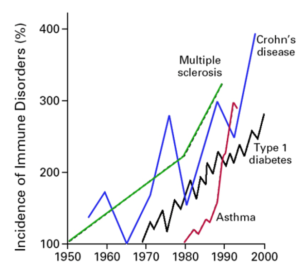
As I have stated in previous posts, this is a phenomenon of the modern industrialized state. The following chart best illustrates the increase in several of the 80 to 100 known autoimmune diseases. Not included in this chart is autism, now considered by many researchers and experts as being an autoimmune-like condition.

The steep increases you see over just a few decades cannot be explained by a genetic cause. Genes do not change that fast, but the environment does. Now, that is not to say that genes are not a player here; they certainly are. Genes associated with autoimmunity may or may not be expressed; they are expressed based on the environment in which you put yourself. Meaning, the genes for autoimmunity and most other chronic diseases are not like the genes for hair or skin color. Hair and skin color genes are phenotypes, and the genes associated with chronic disease are genotype. Genotype is dependent on the environment for the expression of certain traits whereas phenotype is hardwired.
The interaction with our environment is what triggers the “switches” that determine which gene will or will not be expressed.
Examples where our children’s environment has changed in recent decades:
- Mother’s immune health and immune history. The overwhelming majority of women of birthing age, over the past 20 to 30 years are the most vaccinated population who live in the most disinfected homes in human history. Modern industrialized nations like the United States have experienced very little exposure to immune challenges compared to our ancestors and therefore do not pass to their children an effective immune system in the first 6 months of life when the infant does not have his or her own immune system.
It is not my intention to place a judgment on our more than 100-year battle against germs or the wisdom of vaccine science. I am merely stating the indisputable fact of unintended consequences associated with the most vaccinated and sterile environment in human history.
- Feeding our babies: Over recent decades, breastfeeding has become an optional, not very necessary, part of raising our children. Formula feeding does not include the thousands of hormones, peptides, and living immunoglobulin present in mother’s milk. This trend has begun to reverse in recent years, but the damage has been done for more than 40 years.
- Chemical environment – Toxicity: More than 45,000 chemical compounds have been introduced to our daily environment since World War II. That includes flame retardants in our bedding, clothing, and furniture, detergents, solvents, disinfectants, chemicals used in our floors, carpets, and building materials, plastics, food additives, preservatives, fungicides, and pesticides (organophosphates). The list goes on and on. Chemical exposure places added stress on our organs, especially those that detoxify. Our organs of detoxification are our liver, GI tract, kidneys, and sweat glands. They are genetically designed to detoxify us from our own normal metabolism, in the completely organic world of our ancestors. We are assuming these organs of detoxification can handle the extra load. It makes sense that some do a better job than others.
- Funny Food : We are exposed to food proteins that have been dramatically denatured by processing and food proteins that have been altered either through hybridization or modification. To put it simply, our genes have never seen these proteins before and are therefore more likely to result in protection and defense as opposed to tolerance.
- Just like vaccines which have reportedly been responsible for saving so many lives yet have unintended consequences in the realm of immunity, the same holds true for agro-business. Agro-business refers to the industrialized food industry where science, biology, and farming meet. Scientific breakthroughs that have made it possible to cheaply feed billions of people who would otherwise be starving or never born are likely responsible for loss of tolerance to food proteins. Gluten is a great example of this. Celiac disease, a severe form of gluten intolerance, occurred in 1 of every 700 in the 1950s and is now 1 of every 100.
- Food packaging: The problem here is a combination of the “funny food” exposed to chemicals during the packaging process.
I think you get the idea. This topic could easily become a book. We could go on and on.
What can we do to improve the environment and reduce risk of autoimmunity?
- Improve your relationship with food. Eat whole foods that look the way they did when they grew out of the ground or walked on the earth.
- Breastfeed your children.
- Reduce chemical exposure in the home – think detergents, cleaning materials, flame retardant chemicals in bedding, clothing, and furniture.
- Stop being a germaphobe. (Dirt, dust and dander make for a challenged immune system, which results in tolerance.) Let your children play in the dirt all day, then hose them off before bed, only to do it all over again the next day.
- Avoid “frankenfood.” GMOs, pesticides, BPA in packaging, etc. – no explanation needed.
- Get Vitamin D levels checked for yourself and family. They should be 80 to 100 for immune regulation. Consult a functional medicine specialist for the best way to raise those levels.
- If you suspect autoimmunity in the family, get educated on the lifestyle changes needed to live a healthy normal life.
Thanks for reading!

Please use the comments sections below to share your thoughts on these subjects. The more people realize they are not alone, the more empowered they become.

“Meaning, the genes for autoimmunity and most other chronic diseases are not like the genes for hair or skin color. Hair and skin color genes are phenotypes, and the genes associated with chronic disease are genotype. Genotype is dependent on the environment for the expression of certain traits whereas phenotype is hardwired.”
It is certainly true that genes that regulate autoimmunity can differ from genes for hair or skin color in their level of expression. However, the way you explain genotype and phenotype isn’t quite accurate.
A genotype is actually the hard-coded genetic information in our DNA, inherited from our parents and, for the purposes of this article, unchangeable. Every cell in one’s body has the same genotype, or set of genes, as every other cell. (For what it’s worth, genotype can also refer to a particular pair of genes, one from each parent, e.g. someone with blue eyes necessarily has two recessive blue-eye genes, or in Mendelian genetics terms, a “bb” genotype, where “B” for brown eyes would be dominant over “b” for blue eyes, with the corresponding gene from each parent represented by a single letter. I digress.)
A phenotype, on the other hand, is a physical trait that results from the expression of a particular gene or combination of genes, and may be affected by environment. (The “bb” genotype mentioned above results in what we see externally as a “blue eyes” phenotype. A “brown eyes” phenotype may be “Bb” or “bB” or “BB”.) So traits like hair, eye, and skin color are phenotypes resulting from the expression of genes that are essentially always* “turned on”, whereas an autoimmune phenotype may not be expressed unless the genes that control them are activated in response to one or more internal or external environmental triggers.
None of this is really important to the crux of what you’re saying in the rest of the article, but I thought I’d point it out anyway for the sake of completeness.
Thanks for a nice article!
*I should also point out that there is room for environmental influence with these more standard physical traits as well. For example, hair color and texture changes over time and in response to environmental factors, including our body’s own hormones (which are part of the environment for the cells that produce our hair). From personal experience, the texture of my own hair changed from straight-and-fine to coarse-and-wavy when I entered adolescence.