It seems that the 24-hour cycle of sun plays a more significant role in our health than we have ever imagined. If you think that because you do not have insomnia, an abnormal work schedule, sleep apnea, or any other form of sleep disorder that you are safe from the effects of an altered biological clock or circadian rhythm, you’re probably making a grave error. As a matter of fact, the symptoms experienced by altered biological clock functions may be connected to every major chronic health condition we see in increasingly younger populations.
The purpose of this post (and this website, for that matter) is to recognize that our health is dependent on many factors, not just food, exercise, sleep, stress, or spiritual health, etc. Our health, happiness, and energy are dependent on all of these things working in sync.
The first half of this post provides the basic rationale behind understanding a concept that dramatically influences our health related to light exposure and some simple ideas to begin to solve some of these problems. The second half goes deeper into my thought processes, where these ideas come from, and the reason why altered light exposure is of greater concern to our generation than to any generation that came before us.
Part 1 of 2 – What’s the problem, and how do I begin to fix it?
How the cycles of the sun, seasons, and geography impact our health is called chronobiology, the study of circadian rhythms.
“Circadian rhythms can influence sleep-wake cycles, hormone release, body temperature, and other important bodily functions. They have been linked to various sleep disorders, such as insomnia. Abnormal circadian rhythms have also been associated with obesity, diabetes, depression, bipolar disorder, and seasonal affective disorder.”
The biology of the the wake and sleep cycles have long been known, and people who work night shifts have had to suffer many symptoms associated with rhythms of waking and sleeping that are different from our genetic design.
Commonly understood symptoms include:
- Sleep that feels unrefreshing or insufficient
- Difficulty concentrating
- Lack of energy
- Irritability or depression
- Difficulty with personal relationships
Unfortunately, in common medical practices, the understanding ends there, and the treatment is a drug, such as modafinil, which indiscriminately alters neurotransmitter concentrations in key parts of the brain affecting dopamine, serotonin, and epinephrine in order to stimulate wakefulness.
It turns out that circadian biology influences so much more than has been attributed to it in medical practice, and how these rhythms have been altered has not been given due attention.
Circadian biology influences:
- Energy production
- Energy needs (foods we eat)
- Hormone function
- Blood sugar regulation
- Fat metabolism
- Immune health
- Inflammation
- Blood pressure
- Focus and attention
- Mood
- Mental energy
- Digestion
- Weight gain and weight loss
- Vision, macular degeneration
Our circadian biology is negatively impacted by our exposure to everyday sources of light that have only become everyday in recent years for reasons shared further on. For most of human history and mammalian evolution, our exposure to light was limited to the sun and fire. Our physiology that is regulated by the cycles of the sun and seasons is genetically embedded in all of our systems.
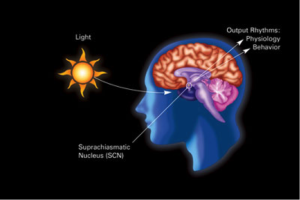
A simple example of how this works: The sun hits your retina at sunrise, and signals are sent to a portion of your brain called the SCN (suprachiasmatic nucleus) in the part of your brain called the hypothalamus. The hypothalamus communicates directly with many parts of your brain and brainstem, but I will focus on the pituitary gland here.
The pituitary gland is in charge of every hormone your body produces, including sex hormones, stress hormones, blood sugar regulating hormones, hormones associated with fat metabolism, the thyroid hormone, etc. There are more than 600 hormones in the human body. This nucleus is directly impacted by light. It should not be a surprise that the hypothalamus is a major area of research as it relates to neurodegenerative diseases, especially Alzheimer’s disease. The light that hits our eyes is different in the morning than it is at midday and late afternoon. It is also different based on the seasons.
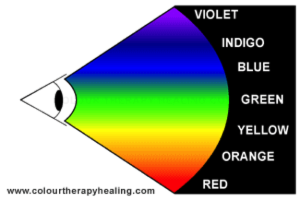
Morning sunlight has a higher percentage of light on the blue end of the spectrum, and as the day progresses, we are exposed to a greater percentage of the red end of the spectrum. This is important because all of your hormonal and energy needs change as the day comes to a close. At sunset, the red end of the spectrum will signal your body to prepare for sleep, healing, and repair. It makes sense that it is different based on our needs.
 The world we live in, unfortunately, is full of blue light in the form of our office fluorescent bulbs, our cellphones, tablets, computer screens, televisions, government-mandated CFL and LED bulbs (incandescent bulbs had a greater quantity of light emitted from the entire spectrum). Basically, we are telling our brain that it is morning and summer time all the time. This is a form of light pollution, it has dramatically increased in recent years, and if you are 20 years old or younger, you’ve never experienced anything else.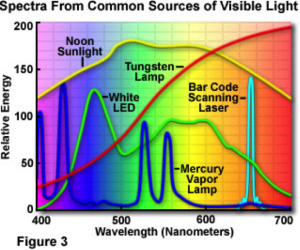
For All You Baby Boomers: Listen up!
The science is in: The blue end of the color spectrum is what is doing damage to our retina, resulting in cataract and macular degeneration. As a matter of fact, the forming of cataracts (cloudiness of the lens resulting in difficulty with eyesight) is more than likely your body’s way of protecting you from the excessive blue light hitting your retina and causing further damage via the SCN of the hypothalamus and the pituitary gland. Unfortunately, the treatment is to remove the lens, allowing more and more of the damaging blue light in. Some doctors are replacing the cataract damaged lenses with blue blocking lenses, and this has shown to be promising.
What can I do about it?
This post barely scratches the surface on the subject of light and electrochemical health, but here are some steps you can take to improve your brain and hormonal health.
- Download a program for your computer from https://justgetflux.com/. This program will automatically emit light from your computer based on the cycle of the sun. Unfortunately, there aren’t programs available for smart phones or tablets as of the writing of this post.
- Wear glasses that block the blue end of the spectrum when indoors, at a computer, using tablets, smartphones, or watching television. There are now clear lenses that are aesthetically pleasing and can be found at www.BLEPeyewear.com. Red lenses are a lot cheaper and accomplish the same blue-blocking effects, but they’re not as attractive, and therefore, people are less likely to wear them in public, school, or at the office.
- People who have dogs find this suggestion the easiest. Be sure to spend 3 to 5 minutes outside at sunrise and sunset. Allow the sun’s rays to hit your retina at those key points of the day. Being in your car or at a window does not count because glass tends to block out the portion of the spectrum we need. Be sure not to wear glasses during these morning and evening sessions.
- Buy incandescent light bulbs for as long as you can. I know they waste energy, what can I say, pick your poison.
- Try out an infrared sauna.
- Drink more water than you ever have before. Yes, water is related to light. That is a whole other post. Don’t worry; we will get there.
Part 2 of 2- Why this is so important now and not so much a generation ago.
Why doctors need to change how they think. My practice and my website will always bring practical application to the latest discoveries in science that impacts our health. I am not tied to a belief system; rather, I am tied to understanding how to make my family, myself, and my patients as healthy and joyful as possible so life can be lived to the fullest.
As doctors, we sometimes invest a lot of time and money studying a subject for weeks, months, and years. We do this so that we may attain a level of expertise so that our “authority” on a given subject can be utilized by our patients for their own benefit and the benefit of society. As doctors, we can then experience a social, financial, moral, and spiritual benefit; it’s why anyone, for the most part, becomes a doctor.
After college, I spent 4 academic years learning about the structure of the body, particularly the spine, and how it interacts with the environment and how gravity plays a significant role in human health. Then, when I felt I mastered those concepts, I wanted to learn more. I wanted to understand the role played by the central nervous system, the brain, on the health of my patients, so I devoted an additional 3 years of academic work and an entire career studying and understanding what I could about the brain.
As I pursued an understanding of the brain in a functional way, I could not deny the role played by all of the other organs and what piqued my interest was the importance of nutrition and our biochemical environment. This led me to study functional medicine and nutrition over a period of years that has made my career incredibly rewarding and unique.
Each of these branches of study did not negate the others; as a matter of fact, each field of study gave validation and expanded my understanding of the others. It has been my experience that most healthcare professionals (medical doctors, acupuncturists, chiropractors, etc.) treat patients like a nail. As the saying goes, if you are trained to be a hammer, then everyone you encounter appears to be a nail. I believe it’s best to be trained like a tool box. Having access to many tools ensures you can get the whole job done.
Now I have embarked on the science of physics to further my understanding of how to help myself, my family, and my patients. Physics was one of my favorite undergraduate subjects. Many of my colleagues saw it as one of the necessary undergraduate hurdles you needed to get past in order to get into graduate school and become a doctor. The relationship of physics to philosophy and understanding the world around us was always very interesting to me, and I felt it was the most basic science needed to explain other fields of science.
To me, the deeper principles of physics were conspicuously missing from the study of biochemistry, especially physiology and nutrition. Now it seems that understanding electrons, protons, photons, electromagnetic fields, and thermodynamics is increasingly becoming very important to understanding why we lose our health or how we get it back. No one cared to know this in the past because technology had not so dramatically altered our biological clocks, physiology, and health as much as it has since 1996. (More on 1996 in just a bit.)
Before the time of Einstein (specifically, 1905), our understanding of how things worked here on Earth, for all intents and purposes, could be sufficiently explained and guided by what was called Newtonian physics. Newtonian physics, based on the works of Sir Isaac Newton, was absolutely correct and valid for what we needed up until the 20th century. Then, Einstein proved that in more extreme environments, either very small, atomic environments, or very big, planetary interstellar environments, or at high speeds and distances, Newtonian physics failed to predict the behavior of the world around us.
Once 20th century technology began to take hold, it became obvious that we would not have satellite technology, space travel, cellphone and internet technology, modern medicine (imaging technology), nano-technology, etc. without a command of physics as it was introduced by Einstein and those who followed his lead.
Now we must recognize that the world of healthcare is going to have to shift away from single-function drugs (blood pressure lowering drugs, cholesterol lowering medication, chemotherapy, etc.) and surgeries to remove failed or “unnecessary” body parts, to a new comprehensive understanding of where our health comes from, not merely reacting to a crisis once health has been lost. Humans are the only mammal in the world who have the ability to change the environment in which they live. We can and have changed virtually everything about our environment, and never has it so dramatically changed than in the last couple of decades.
Dramatic sudden changes in our environment have to have consequences. In many ways, those consequences are very good, and in many ways, those consequences are not very good. I emphasize the negative impact of our environment because I want to solve the problems they cause.
So, why is 1996 so important? That was the year the Internet became of great consequence to everyday life for everyone. Shortly thereafter, WiFi became available to most, and our cellphones became not just phones but personal computers. By 2008, about 2 percent of smartphone function was for use as a telephone, and the rest has become endless personal computing functions. By 2014, most industrialized nations would have phased out the incandescent light bulb in favor of energy saving LED and flourescent (CFL) light bulbs. Since the mid-1990s, the price of electronic goods has dropped dramatically. Most Americans can afford to buy a 54-inch television for each bedroom. People are increasingly binge watching their favorite shows on demand, sometimes in bed, from TVs, tablets, smartphones, or laptops, which have also become increasingly inexpensive and pervasive. Most people make their living sitting for 7-plus hours per day in front of a computer screen.
I have just described a monumental shift in the human environment over the span of 20 years.
 In the 2 or 3 decades prior to that, we had a monumental shift in our environment as it relates to how we produce and process food, so that millions of years of evolution, which is very slow as it relates to where mammals get their food, was instantly changed with farming, growing, fertilizing, processing, storing, and packaging of food processes that are dramatically different from what our species evolved with. Some of the effects of those changes are very good; some, not so much.
Each time we experience such a monumental shift, we experience new challenges. The major shifts in our environment I just described are just 2 of the most recent. There are more, and they go back further. I will be very optimistic and non-cynical for a moment when I say we are a very smart species, and science does a pretty good job identifying the negative consequences of those shifts and adapting.
I believe we can handle this shift if we are smart and move some of the old dinosaurs out of the way. An example of old dinosaurs can be seen in the field of energy production. Oil exploration was a “godsend” for the world at a time when our need for energy was dramatically increasing and our populations of whales to supply that energy were nearly extinct. Now, however, the oil industry (now a dinosaur) will eventually have to get out of the way so newer, cleaner technologies can grab a foothold. The new technologies are not ready to take over yet, but it’s coming, and nothing will stop it.
The same holds true in medicine. The pharmaceutical dinosaurs of old 20th century ways of treating and managing disease have to move out of the way and allow a more modern understanding of health promotion to flourish so we do not have to be reactive to disease and crisis and instead help people experience ever increasing levels of health and performance.
Thanks for reading!

By no means do I have all the answers. Please comment below if you have any resources or solutions I did not mention above as it relates to solving the problem of our altered light environment.

[…] activity regulated by proper circadian rhythm responses affected by light. (See the recent post on this […]